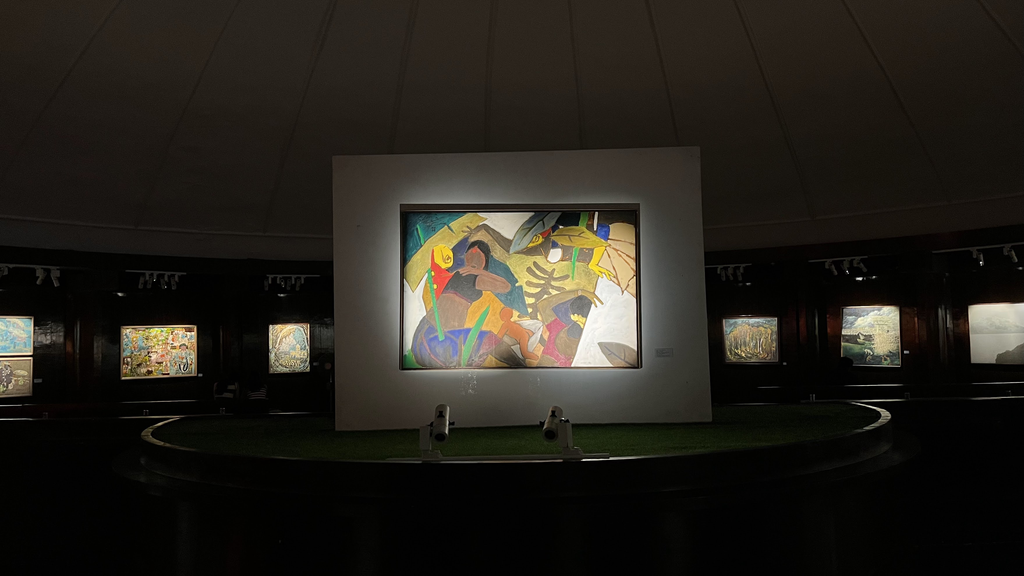
I went to the museum a few months ago and I have been trying to write about it ever since. It kept not arriving. Every time I sat down to start it I’d get three lines in and feel like I was describing a day out instead of the thing that actually happened to me in there, so I’d close it and tell myself it wasn’t ready. Three months of that. So this is me stopping the thinking and just doing it, badly if that’s how it comes.
Mumbai Museum. First time. And I should be honest about what kind of person I am inside a place like that, because it isn’t a casual thing for me — I would happily live in one. I would move in. Things hanging on walls with stories attached to them, and me standing in front of each one for as long as it takes, refusing to miss a detail, going back to the same frame three times because I’m sure there’s something in the bottom left I didn’t give enough time to. I know all of these paintings mean more than what they are showing me. I also know that an artist’s work very often gets recognised for something completely different from what they meant by it, that the thing people love about a painting is sometimes the thing the painter was least interested in, and that there is nothing anybody can do about that. That’s part of the deal you make when you put something on a wall. But I wasn’t in there to decode anything. I wasn’t trying to be clever about it or work out what each one was really saying. I was there to consume it and to blend into whatever that is — the curiosity of the strokes, the decisions somebody made and then painted over, the thing that’s drawn and painted and left raw. There was a photography gallery in there as well, portraits that catch you mid-step and make you forget what you walked in to do, and I think that’s not a small thing to be able to do to a stranger who has never met you and never will.
But here’s the question I kept circling the whole time I was in there, and the one I’ve been circling since. Why do these places do that to you? Why do you walk in and feel, immediately, more creative than you did on the street thirty seconds earlier? Why does a frame hanging on a plain white wall look so unreasonably good? Because it’s a wall. It’s a nail. It’s a rectangle. Nothing about that arrangement should do anything to a person, and yet it does it to everybody, every time, including people who would tell you they don’t care about art.
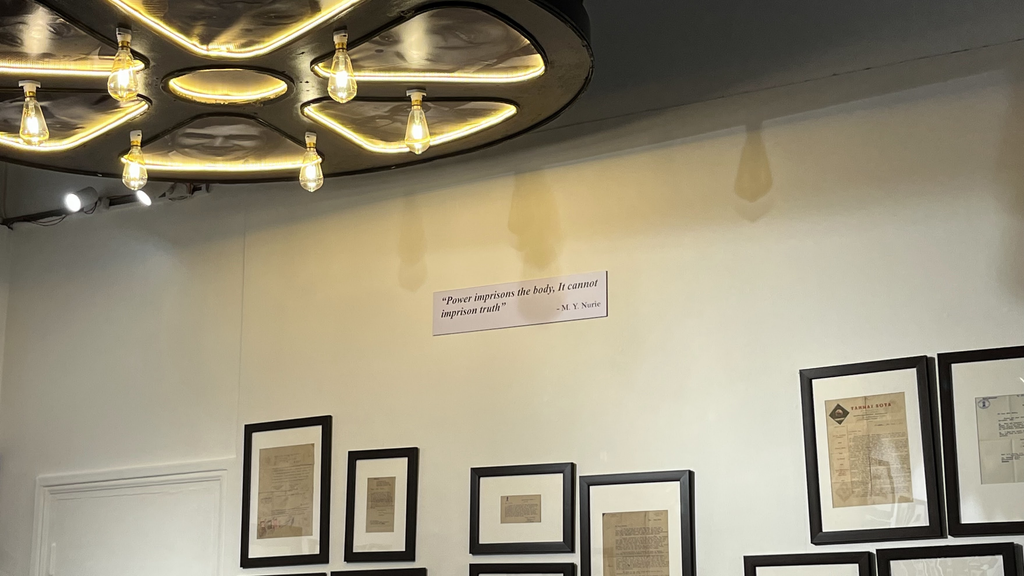
For a long time I assumed the answer was a placebo. You’ve been told this is art, you paid to get in, so you behave the way a person behaves around art. You slow down because everyone else is slowing down. I don’t think that any more. I think it’s the curves. We live inside straight lines now, completely — sharp edges, right angles, grids, screens, roads, buildings, timelines, schedules, calendars, the feed. Everything we’ve built goes from one point directly to another point, because that’s the efficient route and efficiency is more or less the only thing we all agreed on. And then you walk into a room full of things that have no interest in efficiency whatsoever. Curves that were never meant to exist anywhere. Lines that wander off and come back later. Shapes that took the long way round on purpose. Nothing in that room is taking the shortest path between two points, and your eye doesn’t know what to do with it at first, and then it relaxes. Because human beings were never meant to walk in a straight line either. That’s the whole thing. That’s why the room does what it does to you. It isn’t teaching you anything. It’s reminding you of a shape you used to be.
The first museum I ever walked into was in Chandigarh, and I remember thinking even then that we change a lot, faster than we notice. I also had a teacher in college around that time — a painter, a properly recognised one, Sir Jagjit Singh ji. I used to talk to him whenever I got the chance, and the thing I remember about him is not one single word he ever said about technique. It’s that he was calm. Not quiet — calm, which is a different thing. The world could be doing whatever the world does, and he had this steadiness sitting underneath all of it, and I’ve thought about it for years and I think it’s because he knew he was the core of his own thing. He wasn’t waiting around to find out what he was. He’d already settled it. You cannot see that on somebody’s face. You can’t see it in how they look or how they carry themselves or what they’re wearing. You only get it when you talk to them long enough to notice that this is a person with control over himself, and once you’ve noticed it in someone you start looking for it in everyone and mostly not finding it. Sometimes I thank myself for having been his student. He gave me a sense of colour, a sense of curve, a sense of what creativity actually is and how much freedom you’re allowed to take inside it, and everything I’ve dug into since started from there whether I was aware of it or not.
Which is worth saying out loud now, because creativity is sold in bulk these days. You can get your reel edited by an AI. You can get it edited by a person for five hundred rupees. That did not exist when I was learning this, and it isn’t going anywhere, and I’m not going to pretend to be above it because I work in it. But I think that’s exactly why everybody is suddenly starving for calm in a way they weren’t before. Gen Z has a word for the state we’re all chasing — we call it being logged in, which is funny when you think about it for a second, because what we actually mean by it is the exact opposite of a screen.
The museum teaches you the art of observation and the art of observation is mostly one trick, which is this. Look at an image properly. Then close it. Properly forget what you just saw, don’t hold on to it, let it go completely. Then open it again. You will find something in there that wasn’t there a minute ago. A hand you didn’t register. A colour doing something in the corner. A choice. And the thing is, it was always there. You weren’t. That’s the attention I’m talking about, that’s what I mean by noticing, and it is precious and it is the exact thing I have been losing. You can do this with the images in this post if you want to. Look, close, forget, look again.
Something else I keep turning over. You cannot judge a person by their personality — by how they come across in a room, by the bit of them they’ve decided to hand you. You can get a far better sense of someone from their acts, from what they make and what they choose and what they keep doing when nobody is watching them do it. And even then you will be wrong. Ninety-five percent wrong, most of the time, in my experience. Because art closes one room in your mind and opens a different one, and the room it opens for you is not the room it opened for the person who made it. You are never actually looking at their thing. You’re looking at your own thing, standing in front of their thing, and calling the overlap understanding.
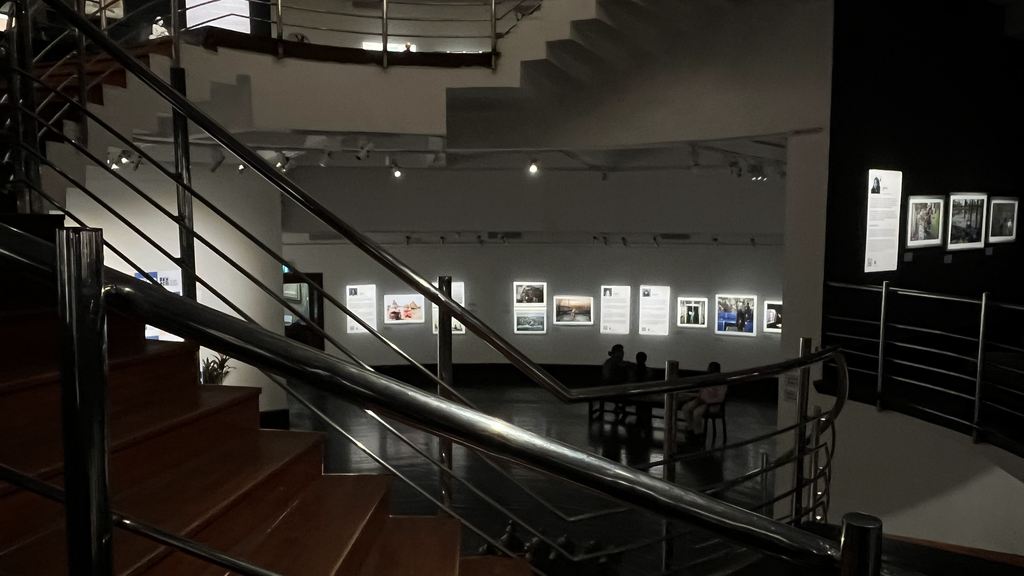
So here’s why I’m actually writing this one, because I’ve written about paintings before and that isn’t new. I’m writing it because of where I was standing when I walked in there. I was becoming the straight line. Point A to point B, efficient, on time, delivering, closing the thing, shipping the thing, moving to the next thing. And I’m in a creative field, which means going directly from A to B is the one skill I genuinely cannot afford to get good at. I need the A2. I need the A3, the A4, the A5, the detour that doesn’t obviously pay for itself. The detour isn’t a waste of the route — in this work it is the route, and the straight line is the thing that quietly kills what you make while looking, from the outside and on a calendar, exactly like productivity. I needed some curves around me and I did not know that about myself until I was standing in a room full of them.
I’m trying to bring old college Naman back. I know you’re not supposed to go backwards, that’s the standard advice and mostly it’s right. But I think you’re allowed to go and collect the good things you left behind there, as long as you’re clear about which ones they are. When I was a kid I had no responsibilities and I used to just watch things. If I saw a light I could see every colour sitting inside it and every ray coming off it, and I could stay with that, and think about it, and feel something about it, and none of that had to produce anything. I want that back. I don’t think it’s gone. I think it’s buried under a schedule.
Writing this, I remembered an activity I used to do and had completely forgotten about. You blind yourself and you sketch. You close your eyes, pull up a moment you remember, and then fill the colour into it. I’m doing it right now, actually. Kasol, with an old friend, a sunset, winter — and I can paint that entire thing out loud without opening my eyes, every colour sitting exactly where it should be, the cold in it, the particular way that light goes. I can do it with a poster. I can do it with a design I haven’t made yet. I can do it with myself, and whenever I do, I’m wearing red. I own exactly one red T-shirt. How does that happen? How does my own head decide that’s what I look like? I used to live inside questions like that for days, stories you could pull out of nothing, and somewhere along the way I stopped asking them because nobody was paying for the answers.
Here’s the last thing. Give a brush to a monkey and it will paint something out of its own life — not well, not in a way we would hang anywhere, but out of its own life. We won’t call that art. But for it, for whatever it has instead of a community, that might be exactly what it is, and I’m not sure we’re the right people to rule on it. And give a brush to a child and he doesn’t paint on the paper at all. He turns the entire room into the canvas — the wall, the floor, the sofa, himself. Nobody taught him that the paper was the limit, because the paper isn’t the limit, it’s just the cheapest surface. That’s the thing we’re trying to hold on to. That’s the sanity.
This has been sitting in my log for three months. I kept waiting until I could say it properly, and then it occurred to me, somewhere in the middle of writing this, that the waiting was the straight line. So I stopped thinking and I did it. Tell me how it lands — comments, a message, email, whatever’s easiest. I’d genuinely like to know what you see in them, because it won’t be what I saw.
naman@samvan.in
– Mumbai, 24th October
Leave a Reply